
India's BFSI sector is set for robust growth, with hiring projected to rise 8.7 per cent in 2025-26 and touch 10 per cent by 2030, creating nearly 2.5 lakh permanent jobs, a report said on Thursday. This growth in the Banking, Financial Services, and Insurance (BFSI) sector is being driven by rising demand in tier II and III cities, marking a clear shift from metro-centric recruitment.

The Reserve Bank of India (RBI) on Wednesday met the long-standing demand of banks by allowing them to finance acquisitions by Indian companies, a move that also expands banks' capital market lending in the country.

As many as 2.17 lakh pieces of fake notes of various denominations were detected during 2024-25 compared to 2.23 lakh such notes in the previous year, Parliament was informed on Monday. Of this, highest -- 117,722 pieces -- counterfeit notes of 500 [MG (New) Series] were detected in FY25, Minister of State for Finance Pankaj Chaudhary said in a written reply in the Lok Sabha.

Reliance Industries' refining earnings will remain steady, supported by its position as India's largest importer of Russian crude and favourable global supplies, according to analysts at JM Financial and Goldman Sachs. Reliance imported more Russian barrels than any other Indian refiner in the past eight months, according to data from Bloomberg/Kpler.

From the 30-share blue-chip pack, Zomato surged over 7 per cent. Maruti, ITC Hotels, ITC, Mahindra & Mahindra, Asian Paints, Titan and IndusInd Bank were among the biggest gainers. Power Grid, Larsen & Toubro, NTPC, UltraTech Cement, HCL Tech, Tech Mahindra, Infosys and Adani Ports were among the laggards.

The Adani group has said it will have a capital expenditure of Rs 1.1 trillion in 2025-26 as against this financial year's Rs 92,000 crore, with a focus on core energy and infrastructure. Expenditure will be financed through an internal cash generation of Rs 60,000 crore, and the rest will be raised via equity and debt, according to senior officials.

MeitY is in discussions with global Fortune 500 and Fortune 1000 companies, mid-tier firms, and state government officials on a three-pronged approach to setting up new GCCs in India.

The country's largest listed gold jewellery maker, Titan Company, maintained its growth pace in the April-June quarter of 2025-26 (FY26).

By acting now, you can step into 2025 with your finances in order and without unnecessary penalties.

With the price of gold entering a strong bull run, gold-loan non-banking financial companies (NBFCs) are under the spotlight, even though their performance is not directly linked to gold price. Muthoot Finance outperformed in the April-June quarter (Q1) of 2025-26 (FY26), with its assets under management (AUM) growing 10 per cent quarter-on-quarter (Q-o-Q) and 42 per cent year-on-year (Y-o-Y), an improvement of 88 basis points (bps) Q-o-Q in net interest margin (NIM), and a fall in credit cost. Gold AUM rose 40 per cent Y-o-Y and 10 per cent Q-o-Q. The company recorded recoveries of 350 crore, including 100 crore from an asset reconstruction company (ARC), resulting in a 100-bp Q-o-Q yield increase.

There are some apparent paradoxes visible in the data from the first quarter of 2025-26 (Q1FY26). The gross domestic product (GDP) delivered a positive surprise with 7.8 per cent year-on-year (Y-o-Y) growth.

Reserve Bank of India (RBI) Governor Sanjay Malhotra said the repo rate cut in the February meeting of the monetary policy committee (MPC) was due to inflation aligning with the target and recognising the fact that monetary policy is forward-looking.
Amid the ongoing global tariff war, Reserve Bank Governor Sanjay Malhotra on Wednesday said he is more worried about its impact on growth than inflation. Speaking to the media after presentation of the first bi-monthly monetary policy for the current financial year, Malhotra said, RBI has reduced the growth forecast for 2025-26 by 20 basis points to 6.5 per cent.

Dwaipayan Bose simplifies the whys and hows of revisiting your financial goals
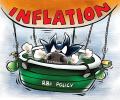
The Reserve Bank of India (RBI) has projected retail inflation at 4.2 percent for the next financial year beginning April while retaining the forecast for 2024-25 at 4.8 percent. The central bank attributed the expected easing of inflation to good kharif production, winter-easing in vegetable prices and favorable rabi crop prospects. However, the RBI also noted that continued uncertainty in global financial markets coupled with volatility in energy prices and adverse weather events presents upside risks to the inflation trajectory.

The World Bank on Wednesday lowered India's growth forecast for the current fiscal by 4 percentage points to 6.3 per cent amid global economic weakness and policy uncertainty. In its previous estimate, the World Bank had projected India's growth at 6.7 per cent for the fiscal year 2025-26.
Defence expenditure was pegged at 1.4 per cent of GDP in the Budget for 2025-26 but it may widen, depending on tensions between India and Pakistan.

ISL clubs warn AIFF of possibility of their shutting down entirely if current impasse not resolved

To ensure a glitch-free rollout of the next-generation GST with reduced rates and lesser slabs, Finance Minister Nirmala Sitharaman chaired three separate meetings to assess GSTN's preparedness and the time it would take to implement technological changes required in the software systems.

Fitch Ratings on Thursday cut India's GDP growth estimate by 10 basis points to 6.4 per cent for the current fiscal, but retained the projections for the next financial year, on concerns over a 'severe' escalation in global trade war. "It is hard to predict US trade policy with any confidence. Massive policy uncertainty is hurting business investment prospects, equity price falls are reducing household wealth, and US exporters will be hit by retaliation," Fitch said in its special update to quarterly Global Economic Outlook (GEO).

The proposed reforms in goods and services tax (GST) announced by the government last week, coupled with the eighth pay commission dole-out, is likely to push consumption-driven stocks - such as air conditioners (ACs), select automobiles, fast-moving consumer goods (FMCG), retail, and counters of quick-service restaurants (QSRs) - into higher orbit over the next few months, believe analysts.

Finance Minister Nirmala Sitharaman on Friday participated in a traditional 'halwa' ceremony, marking the final stage for the preparation of Union Budget 2025-26 to be unveiled on February 1 in the Lok Sabha. The ceremony is a customary ritual in which traditional dessert 'halwa' is prepared and served to officials and staff members of the finance ministry who are involved in the preparation of the Budget.

As part of a plan to refinance debt and expand its upcoming constellation of satellites, French satellite major Eutelsat Communications will raise euro 1.35 billion, or $1.55 billion, through a reserved capital increase and a rights issue, the company announced on Friday. Bharti Enterprises' space venture, Bharti Space Ltd, will invest euro 31.4 million, or $36 million, in the capital raise.

rediffGURU T S Khurana answers readers' personal income tax queries.

GST 2.0 may cushion consumers against US tariffs, but like the 2019 corporate tax cut, it risks being another tactical fix rather than a structural growth strategy, expects Debashis Basu.
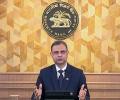
Since February 2025, the RBI has reduced the policy rate by 100 basis points. In its previous policy review in April, it had also trimmed the repo rate by 25 basis points to 6 per cent.

Global firm Accenture's fourth quarter results prove that the worst is behind for the Indian information technology (IT) sector, said analysts on Friday (September 27). While the pace and the broadness of recovery is debatable, they said Accenture's results and revenue growth guidance for the next financial year (FY25) reduce downside risks for Indian IT companies.

Ask rediffGURU and tax expert Mihir Tanna your income tax-related questions.

The country's largest airline IndiGo on Wednesday reported a 20 per cent decline in profit after tax at Rs 2,176.3 crore for the June quarter as airspace curbs and overall challenging operating environment crimped its bottom line even as the carrier flew 12 per cent more passengers during the period.

'About $8.5 billion in free cash, about $3 billion as annual debt refinancing, and $3 billion-4 billion in fresh borrowing. An additional $1.6 billion-1.8 billion will come from development profits in 2025-26.'

The Budget 2025-26 meets the expectations of fiscal consolidation, maintaining capital expenditure, and boosting consumption through tax cuts.

'Due to tariff uncertainty, automotive customers reduced their steel uplift by almost 15 per cent.'
The fiscal deficit for FY25 has been pegged at 4.8 per cent of GDP and at 4.4 per cent for FY26, Finance Minister Nirmala Sitharaman said on Saturday. Presenting the Budget 2025-26, she said net market borrowings are estimated at Rs 11.54 lakh crore for next fiscal year.
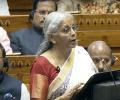
The government aims to initiate "transformative reforms" across six domains, including taxation and financial sector, in Union Budget 2025-26, Finance Minister Nirmala Sitharaman said on Saturday.
Geopolitical tensions, trade policy uncertainties, volatility in international commodity prices and financial market uncertainties pose considerable risks to India's economic growth in the coming year, the finance ministry cautioned on Wednesday. "Global trade continues to be affected by uncertainty in the policy environment... tariff-related developments in multiple countries have heightened trade-related risks, affecting investment and trade flows globally.

Moody's Ratings on Tuesday cut India's GDP growth projections for 2025 to 6.3 per cent, from 6.5 per cent, saying economies globally will see a slowdown on account of heightened US policy uncertainty and trade restrictions.

Fitch Ratings on Tuesday raised India's growth forecast for the current fiscal to 7.2 per cent, from 7 per cent projected in March, saying elevated consumer confidence will drive spending, besides increased investments. In June update to its global economic outlook report, Fitch said it expects inflation to decline to 4.5 per cent by end of this year and RBI to cut policy interest rates by 25 basis points to 6.25 per cent.

Analysts expect Nifty to rise up by to 6 per cent in six months, with intermittent corrections likely due to global factors.

AI and machine learning remain the top focus areas, followed by software development (36 per cent) and cybersecurity (35 per cent).

The Narotam Sekhsaria Scholarships for Higher Studies 2025-26 is designed for students of academic excellence, pursuing postgraduate studies at prestigious institutions in India or abroad.
